
Sounion
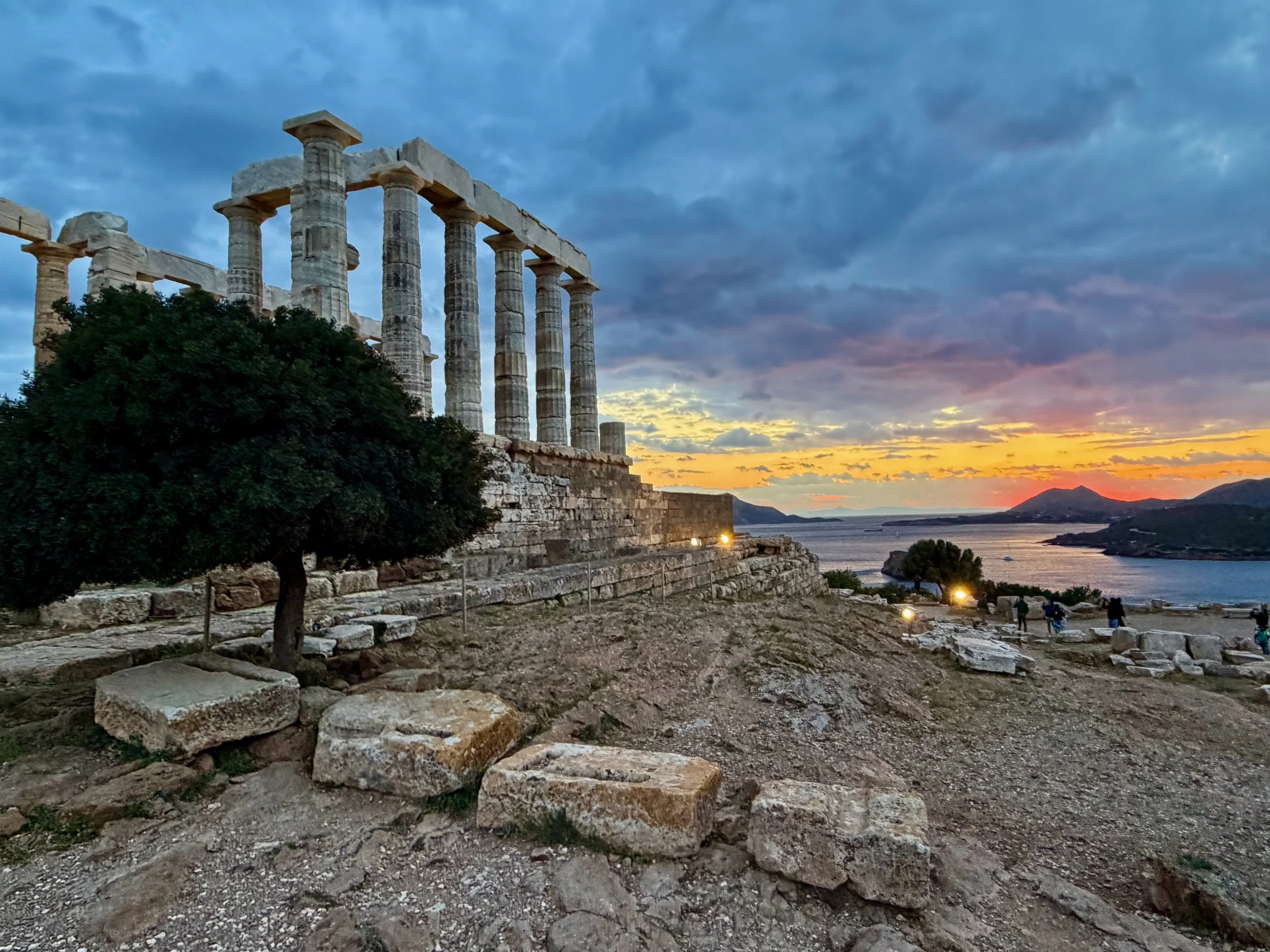
The Greeks called the headland Sounion, or Akron Sounion. The temple stands at the southern tip of Attica, in Greece.
Wikipedia
https://en.wikipedia.org/wiki/Temple_of_Poseidon,_Sounion
Founded
There was a sanctuary on this cape by the eleventh century BCE, and an Archaic temple by the sixth. The Persians destroyed that earlier building in 480 BCE. The marble temple you see now was raised between about 444 and 440 BCE, in the years when Pericles was rebuilding Athens.
Quote
“But when he came to holy Sounion, the cape of Athens, there Phoebus Apollo slew with his gentle shafts the helmsman of Menelaus, Phrontis.”
— Homer, Odyssey 3.278–280
History
Sounion is a working cape before it is a ruin. It is the corner where Attica ends and the Aegean begins, the headland a ship had to round to get from the Saronic Gulf into the open water that leads toward the Cyclades. Athens put a temple to Poseidon on that corner for the same reason a later age put a lighthouse on it. The god who shook the sea was also the god who might let you home.
The first stone temple here was Archaic. The Persians burned it in 480, in the same campaign that left the Acropolis in ashes. A generation later, in the 440s, the Athenians built again in local marble. The new temple was Doric, six columns by thirteen, a sibling in spirit to the work Pericles was ordering in the city. Sixteen of those columns are still standing. The platform hangs on three sides over the water. From the boat the building is a small white comb against the sky. From the terrace the sea is the whole point of the architecture.
Homer already knew the cape. In the Odyssey Menelaus, running home from Troy, loses his helmsman Phrontis at Sounion and buries him there. That is why this listing carries the Odyssey tag. The poem does not describe the marble you see. It describes the headland, which has not moved.
Athens also fortified the cape. In the Peloponnesian War this was a lookout and a small naval station, with shipsheds on the northwest slope. The temple sat in the southeast corner of that fortress. You can still trace wall and terrace if you walk off the postcard angle. Lord Byron carved his name into a column in 1810, which is neither an ancient dedication nor a reason to add your own.
There is a second sanctuary a little inland, to Athena. Most visitors never walk over to it. The Poseidon temple is the one that holds the sunset and the shipping.
Location
Cape Sounion, Lavreotiki, East Attica, Greece.
Coordinates
The temple: 37° 39.01′ N, 024° 01.28′ E
The usual anchorage west of the cape: about 37° 39.4′ N, 024° 01.3′ E
Lavrio marinas, for fuel, water, and a proper berth: the town lies about eight kilometres north.
From the water
This is one of the few sites in the guide that is the landfall. The columns show from a long way off, which is why Venetian sailors called the point Capo Colonne. Closing the cape from the south or west, you see temple, cliff, and open water in a single frame. Sunset is the hour everyone knows about, and for once the crowd is not wrong.
Cruising access
The bay immediately west of the cape is the stop most yachts use. It is not a harbour. It is an anchorage under the temple, with a beach, a couple of tavernas, and a path up to the ticket gate. The bottom is sand over rock and weed in places, and the holding needs to be tested. In a meltemi the cape throws gusts and a wrap of swell. Arrive early in summer. By mid-afternoon the bay is often full.
From the anchorage you can dinghy to the beach and walk up. That is a genuine one-dinghy visit. Lavrio, a short motor north, is where you go when you want a marina, a yard, or a night that does not depend on the hook.
Museum
There is no large museum on the cape. A small site exhibition and the usual boards are at the entrance. The finds that left Sounion live mainly in Athens.
Practical notes
The temple is a short, steep walk from the bay. Give yourself time on the terrace rather than treating it as a ten-minute tick. Sunset is beautiful and crowded. Morning is quieter and better for photographs that do not include a tour group on every step. Stay off the columns. Byron already made the point.
Pilot books
Heikell’s Greek Waters Pilot covers Sounion and Lavrio in the Attica and Saronic pages. Noonsite treats the bay as a useful wait-out for the meltemi and a walk to the temple, which is the right way to think of it.
From here
Lavrio is the practical port and the start of a jump toward Kea and the Cyclades. Thorikos, just north of Lavrio, is the older industrial and theatre site that belongs to this same mining coast. Piraeus and the Acropolis lie back up the Attic shore if you are bound for Athens. Poseidon’s other great coastal mark in this guide is the sea itself. The next temple that watches a cape this cleanly is a different voyage.
“But when he came to holy Sounion, the cape of Athens, there Phoebus Apollo slew with his gentle shafts the helmsman of Menelaus, Phrontis.”
— Homer, Odyssey 3.278–280