
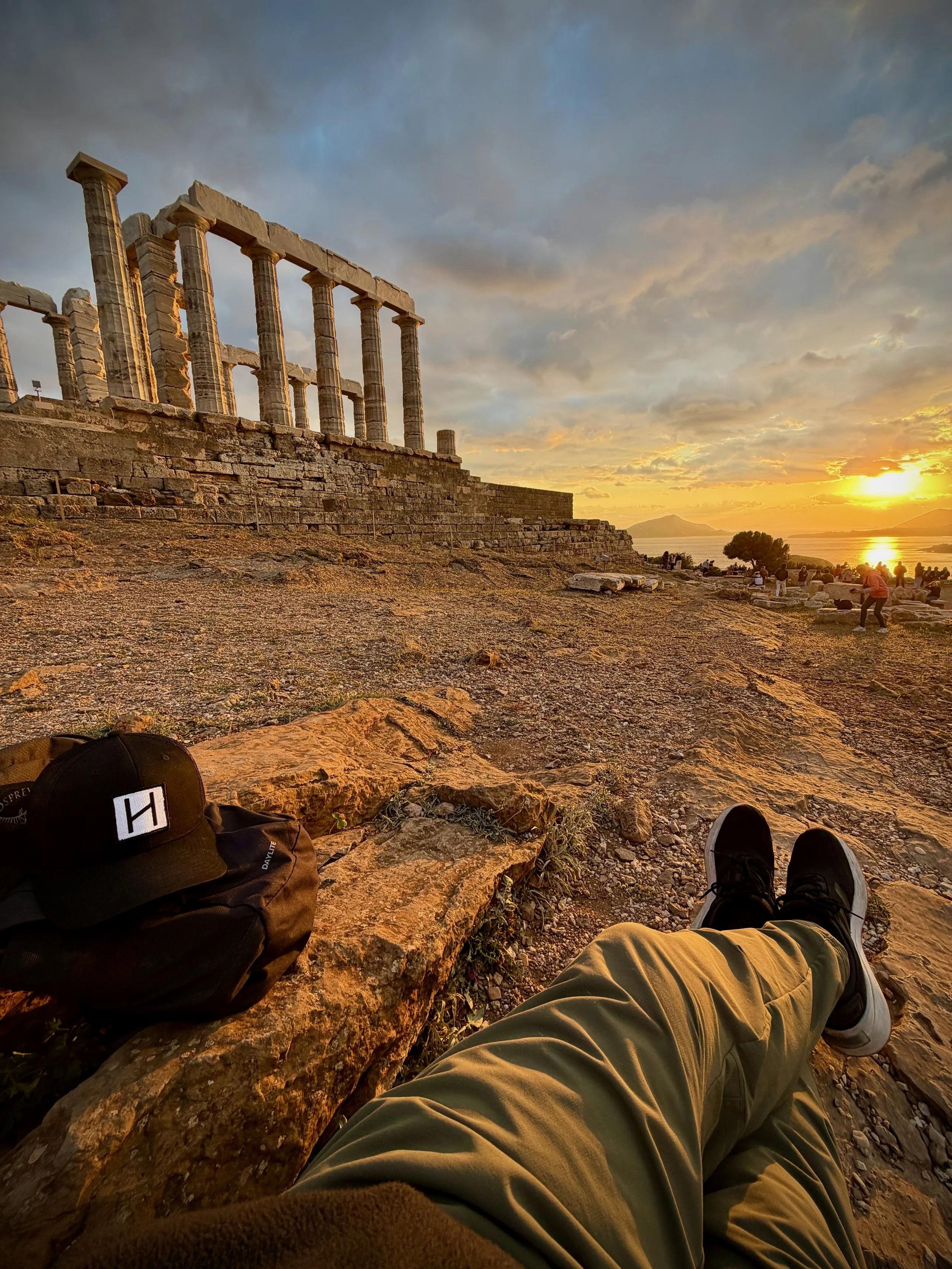
Sounion
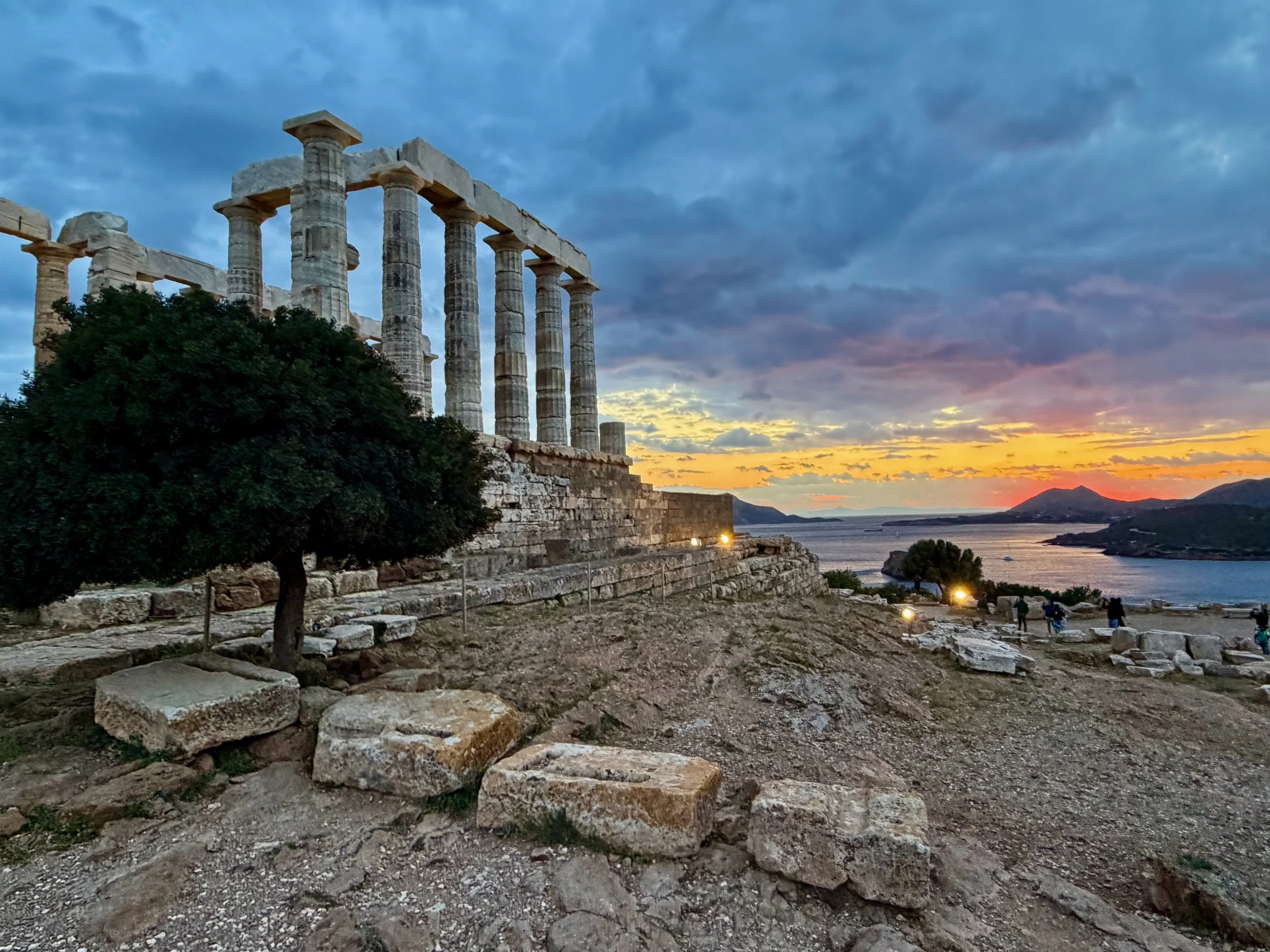
Sounion - White Doric columns on the last cliff of Attica, built for Poseidon, god of the sea, and still the mark every sailor looks for when the land of Athens falls astern.
The Greeks called the headland Sounion, or Akron Sounion. The temple stands at the southern tip of Attica, in Greece.
Wikipedia
https://en.wikipedia.org/wiki/Temple_of_Poseidon,_Sounion
Founded
There was a sanctuary on this cape by the eleventh century BCE, and an Archaic temple by the sixth. The Persians destroyed that earlier building in 480 BCE. The marble temple you see now was raised between about 444 and 440 BCE, in the years when Pericles was rebuilding Athens.
Quote
“But when he came to holy Sounion, the cape of Athens, there Phoebus Apollo slew with his gentle shafts the helmsman of Menelaus, Phrontis.”
— Homer, Odyssey 3.278–280
History
Sounion is a working cape before it is a ruin. It is the corner where Attica ends and the Aegean begins, the headland a ship had to round to get from the Saronic Gulf into the open water that leads toward the Cyclades. Athens put a temple to Poseidon on that corner for the same reason a later age put a lighthouse on it. The god who shook the sea was also the god who might let you home.
The first stone temple here was Archaic. The Persians burned it in 480, in the same campaign that left the Acropolis in ashes. A generation later, in the 440s, the Athenians built again in local marble. The new temple was Doric, six columns by thirteen, a sibling in spirit to the work Pericles was ordering in the city. Sixteen of those columns are still standing. The platform hangs on three sides over the water. From the boat the building is a small white comb against the sky. From the terrace the sea is the whole point of the architecture.
Homer already knew the cape. In the Odyssey Menelaus, running home from Troy, loses his helmsman Phrontis at Sounion and buries him there. That is why this listing carries the Odyssey tag. The poem does not describe the marble you see. It describes the headland, which has not moved.
Athens also fortified the cape. In the Peloponnesian War this was a lookout and a small naval station, with shipsheds on the northwest slope. The temple sat in the southeast corner of that fortress. You can still trace wall and terrace if you walk off the postcard angle. Lord Byron carved his name into a column in 1810, which is neither an ancient dedication nor a reason to add your own.
There is a second sanctuary a little inland, to Athena. Most visitors never walk over to it. The Poseidon temple is the one that holds the sunset and the shipping.
Location
Cape Sounion, Lavreotiki, East Attica, Greece.
Coordinates
The temple: 37° 39.01′ N, 024° 01.28′ E
The usual anchorage west of the cape: about 37° 39.4′ N, 024° 01.3′ E
Lavrio marinas, for fuel, water, and a proper berth: the town lies about eight kilometres north.
From the water
This is one of the few sites in the guide that is the landfall. The columns show from a long way off, which is why Venetian sailors called the point Capo Colonne. Closing the cape from the south or west, you see temple, cliff, and open water in a single frame. Sunset is the hour everyone knows about, and for once the crowd is not wrong.
Cruising access
The bay immediately west of the cape is the stop most yachts use. It is not a harbour. It is an anchorage under the temple, with a beach, a couple of tavernas, and a path up to the ticket gate. The bottom is sand over rock and weed in places, and the holding needs to be tested. In a meltemi the cape throws gusts and a wrap of swell. Arrive early in summer. By mid-afternoon the bay is often full.
From the anchorage you can dinghy to the beach and walk up. That is a genuine one-dinghy visit. Lavrio, a short motor north, is where you go when you want a marina, a yard, or a night that does not depend on the hook.
Museum
There is no large museum on the cape. A small site exhibition and the usual boards are at the entrance. The finds that left Sounion live mainly in Athens.
Practical notes
The temple is a short, steep walk from the bay. Give yourself time on the terrace rather than treating it as a ten-minute tick. Sunset is beautiful and crowded. Morning is quieter and better for photographs that do not include a tour group on every step. Stay off the columns. Byron already made the point.
Pilot books
Heikell’s Greek Waters Pilot covers Sounion and Lavrio in the Attica and Saronic pages. Noonsite treats the bay as a useful wait-out for the meltemi and a walk to the temple, which is the right way to think of it.
From here
Lavrio is the practical port and the start of a jump toward Kea and the Cyclades. Thorikos, just north of Lavrio, is the older industrial and theatre site that belongs to this same mining coast. Piraeus and the Acropolis lie back up the Attic shore if you are bound for Athens. Poseidon’s other great coastal mark in this guide is the sea itself. The next temple that watches a cape this cleanly is a different voyage.
“But when he came to holy Sounion, the cape of Athens, there Phoebus Apollo slew with his gentle shafts the helmsman of Menelaus, Phrontis.”
— Homer, Odyssey 3.278–280
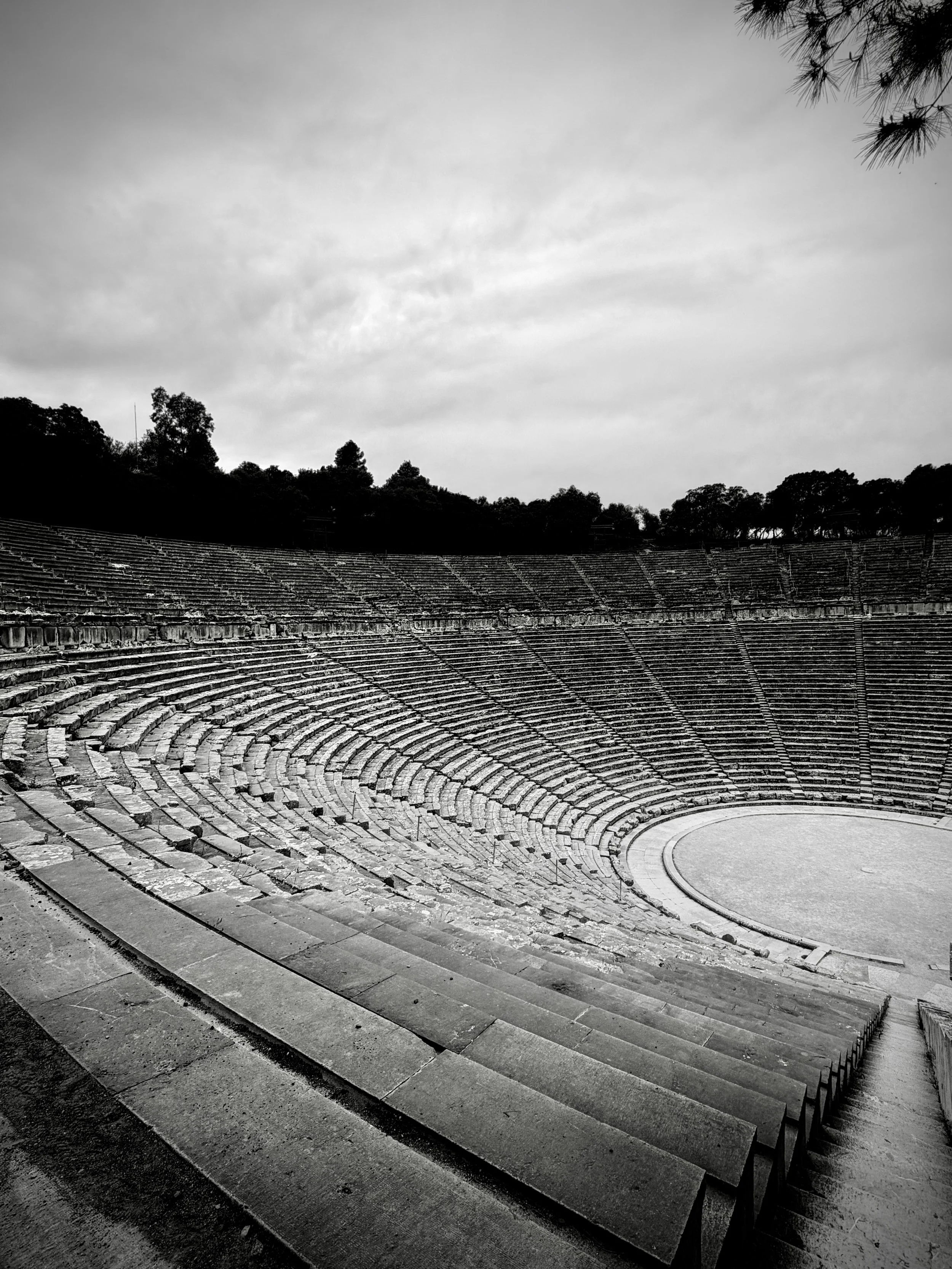
Epidauros
Epidauros -This is the finest surviving Greek theatre, still used in summer, set inside the healing sanctuary of Asklepios a short taxi inland from the Argolic Gulf.
The Greeks called the city Epidauros and the god of the sanctuary Asklepios. The ruins stand in Argolis, in the Peloponnese, in Greece.
Wikipedia
https://en.wikipedia.org/wiki/Epidaurus
Founded
The cult of Asklepios was established on this hillside by the sixth century BCE. The classical temple and the tholos belong to the fourth century BCE. The theatre was built around 340 to 330 BCE and is attributed to Polykleitos the Younger. The seating was enlarged in the second century BCE.
Quote
“The Epidaurian theatre is in my opinion the most beautiful.”
— Pausanias, Description of Greece 2.27.5
History
Epidauros the city sat on the water. What made its name was not that harbour. It was the quiet valley behind Ligourio, where Greeks came to be healed by Asklepios, the physician-god and son of Apollo. A sick person slept in the abaton, dreamed, and waited for the priests to read the dream. The museum still holds the inscribed thank-offerings: eyes restored, a limp corrected, a child finally conceived. The sanctuary was a hospital that spoke the language of a god.
The ground plan is a complete Classical campus rather than a single monument. There is a temple to Asklepios, a stadium, a gymnasium, and a guest house that could hold a crowd. The Romans added baths and a small odeon because the place kept working under the Empire. The circular tholos, designed by Polykleitos, is the building scholars still argue over. It may have been a tomb, an underground rite, or both. On the site you see the concentric foundations. The carved ceiling coffers are in the museum.
Then there is the theatre. That is why a sailor takes the taxi. The seats climb a hollow in the hill in thirty-four tiers, later fifty-five, and hold something like fourteen thousand people. The acoustics are exact enough that a coin dropped on the orchestra can be heard from the last row. The building was raised for the festivals of Asklepios, not as a tourist stage. It now holds the Athens–Epidauros Festival each summer, which is why the tag for theatres still in use is honest here and not a stretch.
UNESCO listed the sanctuary in 1988. French teams began the excavation; Greek teams continued it. What you walk is spread out and green, closer in feeling to Olympia than to the tight citadel at Mycenae. People who only stand in the theatre and turn around have not seen Epidauros.
Keep the two Epidauros sites separate in your head. Palaia Epidavros on the gulf is a pleasant harbour with a small Hellenistic theatre near the quay. You can see that one from a dinghy. You cannot see this one that way.
Location
The Asklepieion of Epidaurus, near Ligourio, Argolis, Peloponnese, Greece.
Coordinates
The sanctuary and the great theatre: 37° 35.76′ N, 023° 04.75′ E
Palaia Epidavros harbour: about 37° 38.3′ N, 023° 09.6′ E
Nafplio, if you want a full-service alternative: about 37° 34.0′ N, 022° 48.0′ E
From the water
The great theatre does not show from the boat. What you see from the Argolic Gulf is the coastal town of Palaia Epidavros and the hills behind it. The sanctuary faces inward, into its own valley. The relationship is still a coastal one. This gulf is how most visitors would have arrived in antiquity, and it is how you will arrive now.
Cruising access
Palaia Epidavros is the closest harbour. The town has its own small theatre, and a taxi from the quay to the Asklepieion takes twenty to twenty-five minutes. Nafplio is farther by road but a better place to leave the boat if you want shops, a yard, and a couple of nights in town. Tolo is another Argolic option and a similar taxi ride.
There is no walk from the great theatre to the sea. Festival weeks in summer tighten both the berths and the taxis. The daytime site ticket is not the same thing as a seat at the play, which you book separately. If you only have the dinghy and no car, walk the little theatre at Palaia and save the great cavea for a day when you have wheels.
Museum
The museum at the entrance to the Asklepieion holds architectural sculpture from the tholos and the temple, votive inscriptions, and medical reliefs. It is part of the same visit, not an optional add-on.
Practical notes
Drop a coin on the orchestra if you want to. It still works, and everyone does it. Morning is the time for an empty theatre. Late afternoon is kinder to the stone. Pair the sanctuary with a night in Nafplio rather than with Mycenae in the same rushed day unless you have a car and start at opening. Adding both citadels and this theatre to one calendar square is how all three get flattened.
Pilot books
Heikell’s Greek Waters Pilot covers the Argolic Gulf, Palaia Epidavros, and Nafplio. Use it for the harbour. The sanctuary is the inland excursion.
From here
Palaia Epidavros is the harbour and the small waterside theatre. Nafplio is where most people will want the boat to stay. Mycenae and Tiryns belong to the same gulf and a different century. Delphi is the other sanctuary in this guide where a god still had a speaking part. If you time the summer festival, Athens and this theatre become one circuit rather than two separate plans.
“The Epidaurian theatre is in my opinion the most beautiful.”
— Pausanias, Description of Greece 2.27.5
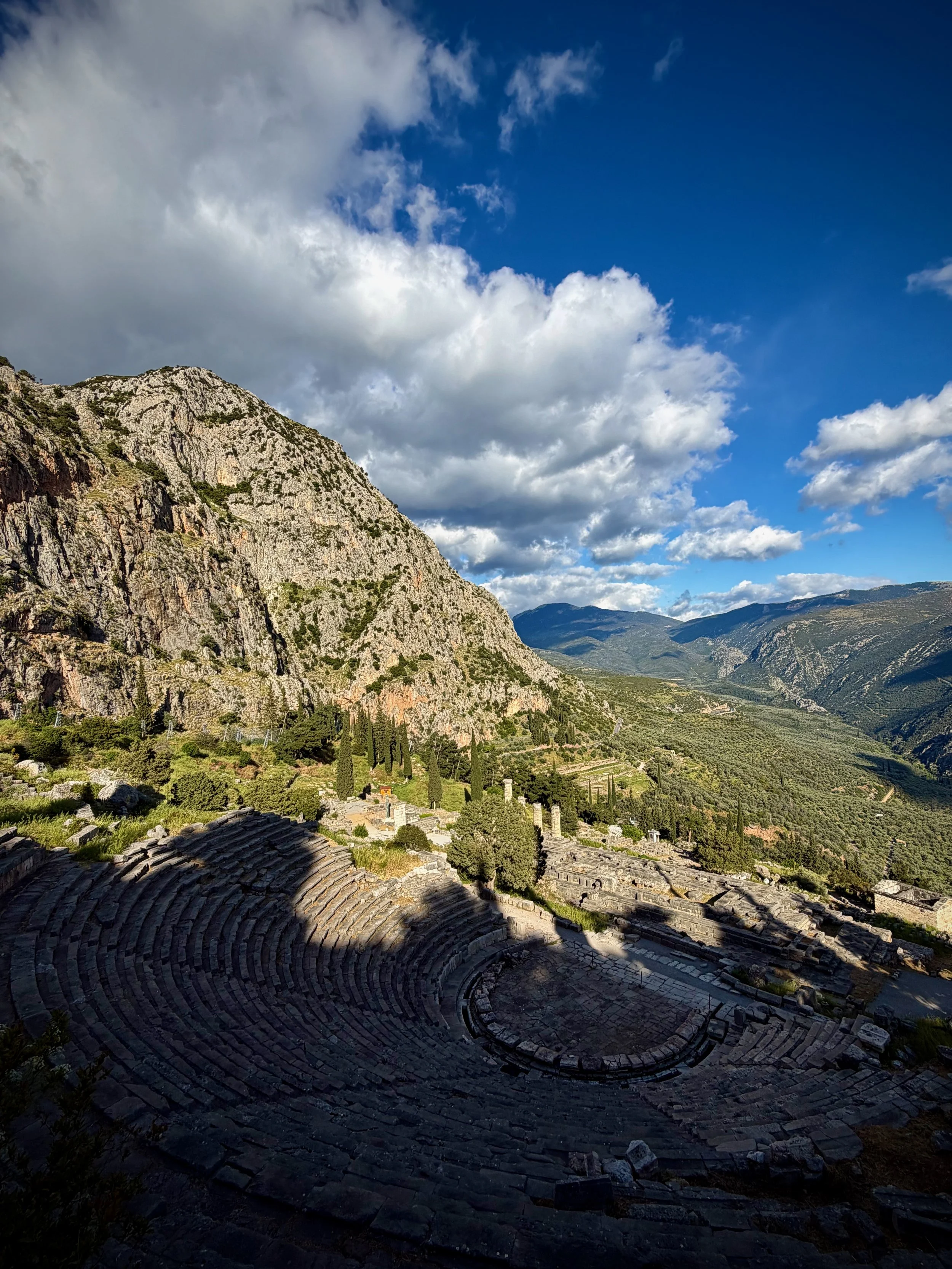
Delphi
Delphi - This is Apollo’s oracle on the mountain, the place Greek cities treated as the navel of their world, and the place where a general might still ask whether he ought to put to sea.
The Greeks called it Delphoi. An older name for the same slope was Pytho. The sanctuary stands in Phocis, in Greece, on the south face of Mount Parnassus.
Wikipedia
https://en.wikipedia.org/wiki/Delphi
Founded
People were using this hillside by the late Geometric and early Archaic centuries, in the 800s and 700s BCE. The Temple of Apollo was rebuilt after a fire in 548 BCE and again after an earthquake in 373 BCE. The sanctuary was closed in the late fourth century CE.
Quote
“I know the number of the sands and the measure of the sea.”
— the Pythia to Croesus of Lydia, recorded by Herodotus in Histories 1.47
History
Delphi was never a harbour town that later acquired a famous temple. It was a sanctuary that made the harbours below it matter. Greeks said two eagles sent out by Zeus met over this slope, and that the stone in the inner room of the temple was the omphalos, the navel of the earth. The god who owned the place was Apollo. In the Homeric Hymn to Apollo he kills the serpent that held the shrine and takes it for himself. The priestess who spoke for him was the Pythia. Cities sent her questions. They also sent treasure, which is why the path up the hill is lined with treasuries rather than houses.
You walk that path still. It is called the Sacred Way, and it switchbacks through the dedications of one city-state after another. The Athenian Treasury has been rebuilt and still stands on its terrace. Athens put a portion of Marathon into that building, and a portion of civic pride along with it. The Siphnian Treasury was richer. Most of it now lives in the museum. Above the treasuries the Temple of Apollo is a platform and a stand of columns rather than a complete room, which is enough. The theatre rests against the temple’s shoulder and is still used in summer. Higher still, the stadium held the Pythian Games, Apollo’s answer to what Zeus had at Olympia.
Herodotus is the writer who makes this hillside useful to a sailor. Croesus asked whether he should make war on Persia and was told that he would destroy a great empire. He did. It was his own. Before Salamis the Athenians were told to trust the wooden wall. Themistocles read the oracle as a fleet, not as a fence around the Acropolis. After the Persian Wars the Greeks raised the Serpent Column from the spoils of Plataea. The column later went to Constantinople, but the argument was made here.
Alexander came to Delphi. Hellenistic kings and Roman emperors came after him, Hadrian among them. Nero carried statues away. By late antiquity the voice of the place had thinned, and the Christian emperors shut the oracle down. The village of Kastri sat on top of the ruins until French excavators began to move it in 1892. The terraces you walk now are that excavation.
For anyone using this guide, Delphi is the clearest example of an oracle sanctuary that still has to be reached from a working gulf harbour. You do not sail to the Pythia. You sail to Itea or Galaxidi, and then you climb.
Location
Delphi, Phocis, Greece, on the south slope of Mount Parnassus.
Coordinates
The sanctuary: 38° 28.95′ N, 022° 30.05′ E
Itea port and marina, the nearest working quay: about 38° 26.0′ N, 022° 25.5′ E
Galaxidi harbour: about 38° 22.6′ N, 022° 23.0′ E
From the water
You will not see the temple from the cockpit. What you see from the Corinthian Gulf is Parnassus and a fold of hills. The sanctuary faces the valley, not the sea. The relationship is still a maritime one. The gulf is how most visitors from the west would have arrived, and it is how you will arrive if you are coming by boat.
Cruising access
Galaxidi is the harbour to aim for if you have a choice. It is well sheltered, the town is pleasant, and a taxi to Delphi takes something like half an hour to forty minutes. Itea is closer, perhaps twenty or twenty-five minutes by road, but it is a working and commercial port and a less comfortable place to leave the boat.
There is no question of walking from the quay to the ruins. The site sits well inland and well up. In summer the coaches from Athens fill the terraces by mid-morning, so an early start from the harbour is worth the alarm. In winter the opening hours shrink. The gulf passage itself is straightforward from the Corinth Canal or from the northern Peloponnese. The mountain road is the only part of the day that asks for patience.
Museum
The Delphi Archaeological Museum stands next to the sanctuary and should not be treated as an extra. The bronze Charioteer is here, along with the Siphnian frieze, the omphalos, and a great deal of ivory and bronze that the hillside itself no longer holds. The ticket is usually combined with the archaeological site.
Practical notes
Give the place three or four hours if you mean to see both the slope and the museum. The Castalian Spring is beside the road as you come in. Afternoon light is kinder to the temple terrace and the theatre. The museum is kinder if you walk through it while you are still fresh. A night in Galaxidi after the visit is a better plan than driving back toward the Canal in the same afternoon.
Pilot books
Heikell’s Greek Waters Pilot covers the Corinthian Gulf, Itea, and Galaxidi. Look there for the harbour, not for a plan of the sanctuary.
From here
Galaxidi is the place you will actually want to spend the evening. Ancient Corinth and the harbour at Lechaion sit at the other end of the same gulf, on the far side of the Canal. Delos is Apollo’s island sanctuary, in a different sea and a different week of the voyage. Olympia is the other great pan-Hellenic gathering place; it is also a taxi ride, this time from a harbour on the west coast of the Peloponnese.
Delphi
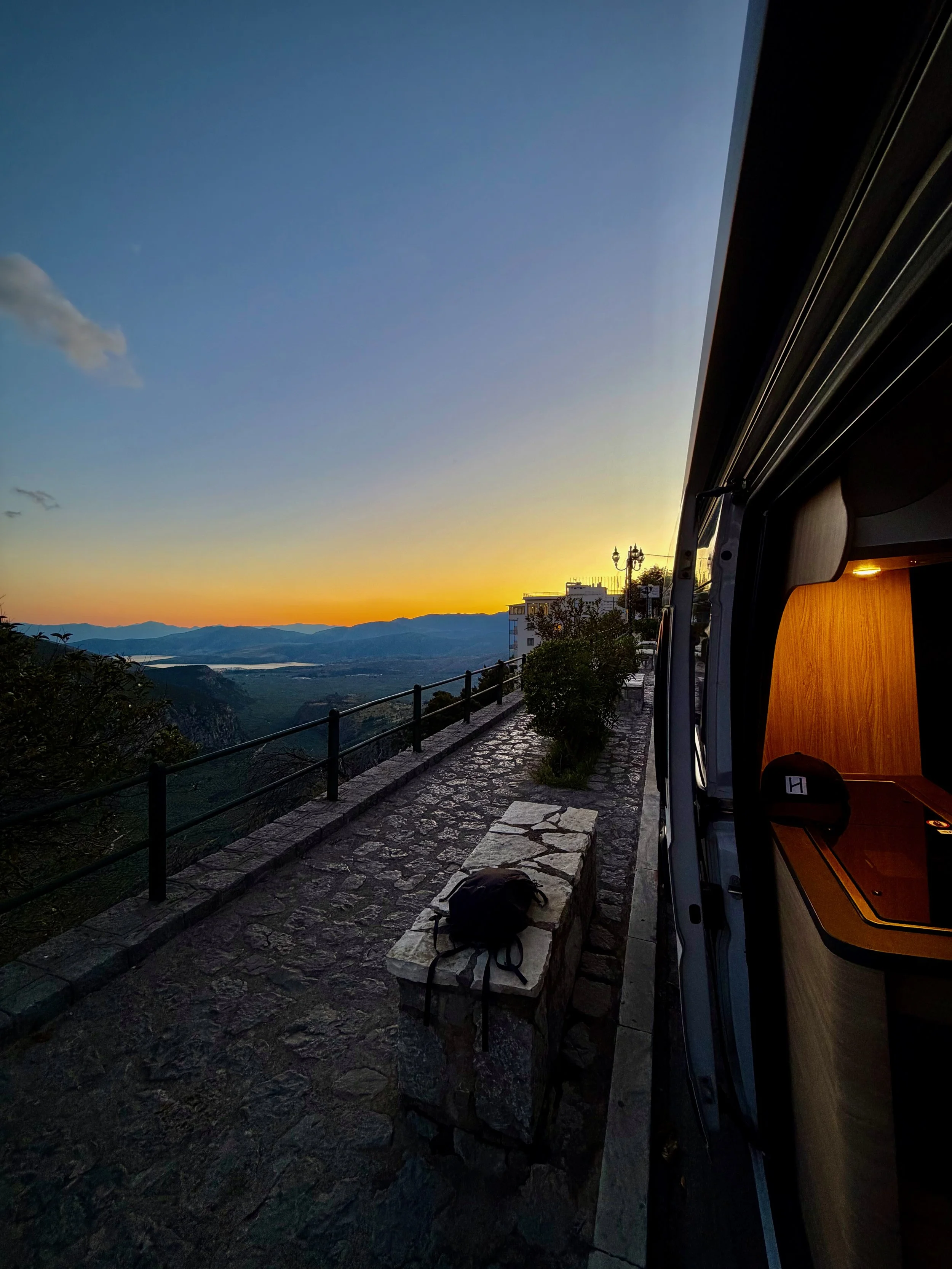
Stick around in town for a late evening meal after visiting Delphi