
Epidauros
The Greeks called the city Epidauros and the god of the sanctuary Asklepios. The ruins stand in Argolis, in the Peloponnese, in Greece.
Wikipedia
https://en.wikipedia.org/wiki/Epidaurus
Founded
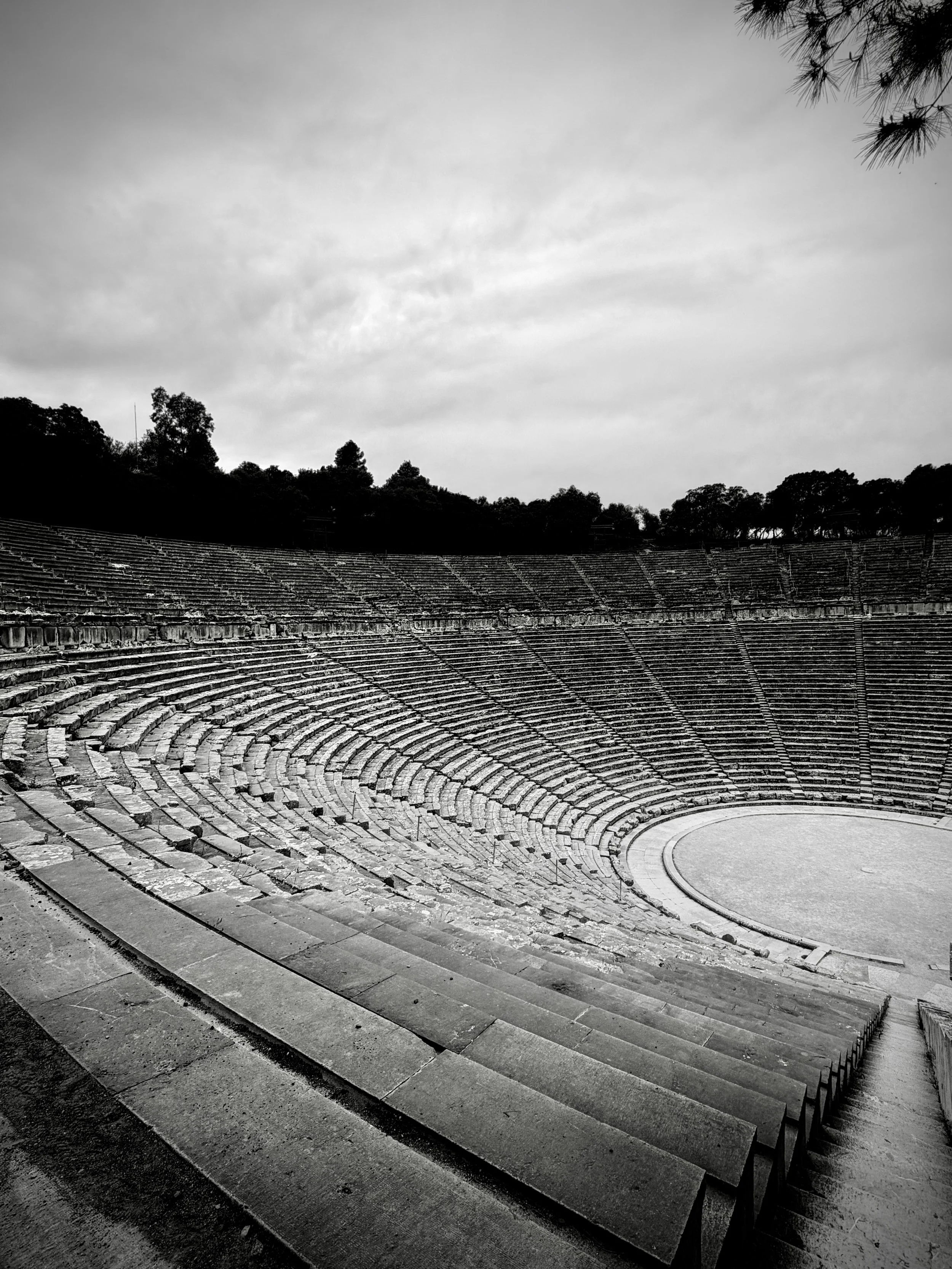
The cult of Asklepios was established on this hillside by the sixth century BCE. The classical temple and the tholos belong to the fourth century BCE. The theatre was built around 340 to 330 BCE and is attributed to Polykleitos the Younger. The seating was enlarged in the second century BCE.
Quote
“The Epidaurian theatre is in my opinion the most beautiful.”
— Pausanias, Description of Greece 2.27.5
History
Epidauros the city sat on the water. What made its name was not that harbour. It was the quiet valley behind Ligourio, where Greeks came to be healed by Asklepios, the physician-god and son of Apollo. A sick person slept in the abaton, dreamed, and waited for the priests to read the dream. The museum still holds the inscribed thank-offerings: eyes restored, a limp corrected, a child finally conceived. The sanctuary was a hospital that spoke the language of a god.
The ground plan is a complete Classical campus rather than a single monument. There is a temple to Asklepios, a stadium, a gymnasium, and a guest house that could hold a crowd. The Romans added baths and a small odeon because the place kept working under the Empire. The circular tholos, designed by Polykleitos, is the building scholars still argue over. It may have been a tomb, an underground rite, or both. On the site you see the concentric foundations. The carved ceiling coffers are in the museum.
Then there is the theatre. That is why a sailor takes the taxi. The seats climb a hollow in the hill in thirty-four tiers, later fifty-five, and hold something like fourteen thousand people. The acoustics are exact enough that a coin dropped on the orchestra can be heard from the last row. The building was raised for the festivals of Asklepios, not as a tourist stage. It now holds the Athens–Epidauros Festival each summer, which is why the tag for theatres still in use is honest here and not a stretch.
UNESCO listed the sanctuary in 1988. French teams began the excavation; Greek teams continued it. What you walk is spread out and green, closer in feeling to Olympia than to the tight citadel at Mycenae. People who only stand in the theatre and turn around have not seen Epidauros.
Keep the two Epidauros sites separate in your head. Palaia Epidavros on the gulf is a pleasant harbour with a small Hellenistic theatre near the quay. You can see that one from a dinghy. You cannot see this one that way.
Location
The Asklepieion of Epidaurus, near Ligourio, Argolis, Peloponnese, Greece.
Coordinates
The sanctuary and the great theatre: 37° 35.76′ N, 023° 04.75′ E
Palaia Epidavros harbour: about 37° 38.3′ N, 023° 09.6′ E
Nafplio, if you want a full-service alternative: about 37° 34.0′ N, 022° 48.0′ E
From the water
The great theatre does not show from the boat. What you see from the Argolic Gulf is the coastal town of Palaia Epidavros and the hills behind it. The sanctuary faces inward, into its own valley. The relationship is still a coastal one. This gulf is how most visitors would have arrived in antiquity, and it is how you will arrive now.
Cruising access
Palaia Epidavros is the closest harbour. The town has its own small theatre, and a taxi from the quay to the Asklepieion takes twenty to twenty-five minutes. Nafplio is farther by road but a better place to leave the boat if you want shops, a yard, and a couple of nights in town. Tolo is another Argolic option and a similar taxi ride.
There is no walk from the great theatre to the sea. Festival weeks in summer tighten both the berths and the taxis. The daytime site ticket is not the same thing as a seat at the play, which you book separately. If you only have the dinghy and no car, walk the little theatre at Palaia and save the great cavea for a day when you have wheels.
Museum
The museum at the entrance to the Asklepieion holds architectural sculpture from the tholos and the temple, votive inscriptions, and medical reliefs. It is part of the same visit, not an optional add-on.
Practical notes
Drop a coin on the orchestra if you want to. It still works, and everyone does it. Morning is the time for an empty theatre. Late afternoon is kinder to the stone. Pair the sanctuary with a night in Nafplio rather than with Mycenae in the same rushed day unless you have a car and start at opening. Adding both citadels and this theatre to one calendar square is how all three get flattened.
Pilot books
Heikell’s Greek Waters Pilot covers the Argolic Gulf, Palaia Epidavros, and Nafplio. Use it for the harbour. The sanctuary is the inland excursion.
From here
Palaia Epidavros is the harbour and the small waterside theatre. Nafplio is where most people will want the boat to stay. Mycenae and Tiryns belong to the same gulf and a different century. Delphi is the other sanctuary in this guide where a god still had a speaking part. If you time the summer festival, Athens and this theatre become one circuit rather than two separate plans.
“The Epidaurian theatre is in my opinion the most beautiful.”
— Pausanias, Description of Greece 2.27.5