
The Greeks called it Olympia. The sanctuary stands in Elis, in the western Peloponnese, in Greece.
Wikipedia
https://en.wikipedia.org/wiki/Olympia,_Greece
Founded
The sacred grove was already old when the first recorded Olympic Games were held in 776 BCE. The Temple of Zeus was built between about 470 and 456 BCE. Phidias finished the gold-and-ivory statue of Zeus around 430 BCE. The games continued under Roman rule and were banned by Theodosius in 393 CE.
Quote
“If Zeus were to stand up, he would unroof the temple.”
— Strabo on the statue of Zeus, Geography 8.3.30
History
Olympia was never a city in the ordinary sense. It was a sanctuary in a river valley, a place Greeks came to for the festival of Zeus and for the games that grew out of it. The traditional date for the first recorded games is 776 BCE. For more than a thousand years after that, every fourth summer, athletes and spectators crossed the Mediterranean under a sacred truce. Wars paused. Ships sailed. The prize was an olive wreath and a name that lasted.
You walk the Altis, the sacred enclosure. The Temple of Zeus is the largest building, a Doric temple raised in the fifth century after Elis defeated Pisa for control of the sanctuary. Inside it stood the chryselephantine statue of Zeus by Phidias, one of the Seven Wonders of the Ancient World. The statue is gone. Phidias’s workshop is still there, and the museum holds the pediment sculptures and the metopes of the labours of Heracles. The columns of the temple lie where an earthquake dropped them. That is the photograph most people take.
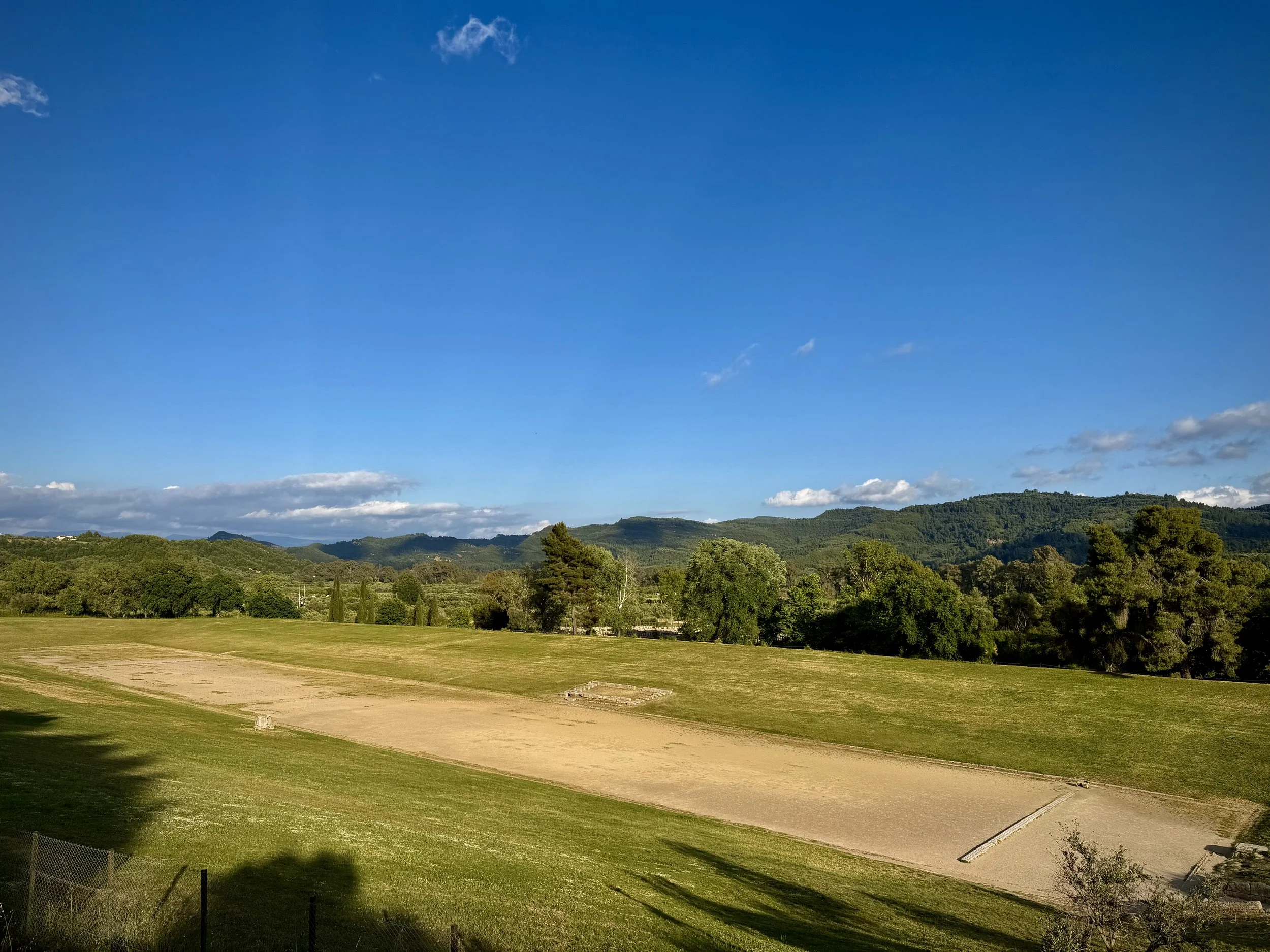
The older Temple of Hera stands nearby. It is the building in front of which the modern Olympic flame is lit. The stadium, with its vaulted entrance tunnel, is where the foot races were run. The palaestra and gymnasium are the training grounds. The Philippeion, a small circular building, was raised by Philip II of Macedon after Chaeronea. Roman baths and an odeon were added later because the sanctuary kept working under the Empire.
Herodotus mentions Olympia. Pindar wrote odes for the victors. During the Peloponnesian War the games continued under the truce even while the cities that sent athletes were fighting each other. That is why the listing carries those tags. After 393 the games ended. Earthquakes and the silt of the Alpheios and Kladeos rivers buried the place. German excavators began to clear it in 1875. UNESCO listed the site in 1989.
For a sailor the important fact is that the sanctuary sits well inland. You do not sail to the Temple of Zeus. You sail to Katakolon on the Ionian coast, and then you take a taxi or the seasonal train.
Location
Ancient Olympia, Elis, western Peloponnese, Greece.
Coordinates
The sanctuary: about 37° 38.3′ N, 021° 37.8′ E
Katakolon harbour: about 37° 38.8′ N, 021° 19.3′ E
From the water
You will not see Olympia from the boat. What you see from the Ionian Sea is the low coast around Katakolon and the hills behind it. The sanctuary faces inland, into its own valley. The relationship is still a coastal one. This is the west-coast door to the same Peloponnese you have already been walking on the east side.
Cruising access
Katakolon is the harbour to aim for. It is a working port with a marina, and it is the usual cruise-ship stop for Olympia. The road distance is about 34 to 38 kilometres, which is roughly forty minutes by taxi. There is also a seasonal train from Katakolon to Olympia when the schedule is running. Agree the return fare and the pickup time before you leave the quay if you are taking a taxi.
There is no dinghy landing at the ruins. The site sits well outside the five-kilometre marina rule. It is still a reasonable day from a boat that has put in on this coast. In summer the coaches from the cruise ships fill the Altis by mid-morning, so an early start is worth the alarm.
Museum
The Archaeological Museum of Olympia stands next to the site and is not optional if you care about what the buildings once held. The pediment sculptures from the Temple of Zeus, the Nike of Paionios, and the Hermes of Praxiteles are here. The ticket is usually combined with the archaeological site.
Practical notes
Give the place a full half-day if you mean to see both the Altis and the museum. The stadium is a short walk beyond the main ruins and is easy to miss if you turn around at the Temple of Zeus. Morning light is better on the columns. The museum is better while you are still fresh. Pair the visit with a night in Katakolon rather than trying to make the same day serve another major site.
Pilot books
Heikell’s Greek Waters Pilot covers Katakolon and the Ionian coast. Use it for the harbour. Olympia is the inland excursion.
From here
Katakolon is where the boat will be waiting. The Ionian islands lie to the west if you are continuing that way. Delphi is the other great pan-Hellenic sanctuary in this guide, on the far side of the Peloponnese and the Corinthian Gulf. Epidauros is the theatre that belongs to the same world of festivals. The Acropolis in Athens holds the other great work of Phidias, the statue of Athena that once stood in the Parthenon.
“If Zeus were to stand up, he would unroof the temple.”
— Strabo on the statue of Zeus, Geography 8.3.30