

Olympia
Olympia - This is the sanctuary of Zeus where the Olympic Games began, and the place that once held one of the Seven Wonders of the Ancient World.
The Greeks called it Olympia. The sanctuary stands in Elis, in the western Peloponnese, in Greece.
Wikipedia
https://en.wikipedia.org/wiki/Olympia,_Greece
Founded
The sacred grove was already old when the first recorded Olympic Games were held in 776 BCE. The Temple of Zeus was built between about 470 and 456 BCE. Phidias finished the gold-and-ivory statue of Zeus around 430 BCE. The games continued under Roman rule and were banned by Theodosius in 393 CE.
Quote
“If Zeus were to stand up, he would unroof the temple.”
— Strabo on the statue of Zeus, Geography 8.3.30
History
Olympia was never a city in the ordinary sense. It was a sanctuary in a river valley, a place Greeks came to for the festival of Zeus and for the games that grew out of it. The traditional date for the first recorded games is 776 BCE. For more than a thousand years after that, every fourth summer, athletes and spectators crossed the Mediterranean under a sacred truce. Wars paused. Ships sailed. The prize was an olive wreath and a name that lasted.
You walk the Altis, the sacred enclosure. The Temple of Zeus is the largest building, a Doric temple raised in the fifth century after Elis defeated Pisa for control of the sanctuary. Inside it stood the chryselephantine statue of Zeus by Phidias, one of the Seven Wonders of the Ancient World. The statue is gone. Phidias’s workshop is still there, and the museum holds the pediment sculptures and the metopes of the labours of Heracles. The columns of the temple lie where an earthquake dropped them. That is the photograph most people take.
The older Temple of Hera stands nearby. It is the building in front of which the modern Olympic flame is lit. The stadium, with its vaulted entrance tunnel, is where the foot races were run. The palaestra and gymnasium are the training grounds. The Philippeion, a small circular building, was raised by Philip II of Macedon after Chaeronea. Roman baths and an odeon were added later because the sanctuary kept working under the Empire.
Herodotus mentions Olympia. Pindar wrote odes for the victors. During the Peloponnesian War the games continued under the truce even while the cities that sent athletes were fighting each other. That is why the listing carries those tags. After 393 the games ended. Earthquakes and the silt of the Alpheios and Kladeos rivers buried the place. German excavators began to clear it in 1875. UNESCO listed the site in 1989.
For a sailor the important fact is that the sanctuary sits well inland. You do not sail to the Temple of Zeus. You sail to Katakolon on the Ionian coast, and then you take a taxi or the seasonal train.
Location
Ancient Olympia, Elis, western Peloponnese, Greece.
Coordinates
The sanctuary: about 37° 38.3′ N, 021° 37.8′ E
Katakolon harbour: about 37° 38.8′ N, 021° 19.3′ E
From the water
You will not see Olympia from the boat. What you see from the Ionian Sea is the low coast around Katakolon and the hills behind it. The sanctuary faces inland, into its own valley. The relationship is still a coastal one. This is the west-coast door to the same Peloponnese you have already been walking on the east side.
Cruising access
Katakolon is the harbour to aim for. It is a working port with a marina, and it is the usual cruise-ship stop for Olympia. The road distance is about 34 to 38 kilometres, which is roughly forty minutes by taxi. There is also a seasonal train from Katakolon to Olympia when the schedule is running. Agree the return fare and the pickup time before you leave the quay if you are taking a taxi.
There is no dinghy landing at the ruins. The site sits well outside the five-kilometre marina rule. It is still a reasonable day from a boat that has put in on this coast. In summer the coaches from the cruise ships fill the Altis by mid-morning, so an early start is worth the alarm.
Museum
The Archaeological Museum of Olympia stands next to the site and is not optional if you care about what the buildings once held. The pediment sculptures from the Temple of Zeus, the Nike of Paionios, and the Hermes of Praxiteles are here. The ticket is usually combined with the archaeological site.
Practical notes
Give the place a full half-day if you mean to see both the Altis and the museum. The stadium is a short walk beyond the main ruins and is easy to miss if you turn around at the Temple of Zeus. Morning light is better on the columns. The museum is better while you are still fresh. Pair the visit with a night in Katakolon rather than trying to make the same day serve another major site.
Pilot books
Heikell’s Greek Waters Pilot covers Katakolon and the Ionian coast. Use it for the harbour. Olympia is the inland excursion.
From here
Katakolon is where the boat will be waiting. The Ionian islands lie to the west if you are continuing that way. Delphi is the other great pan-Hellenic sanctuary in this guide, on the far side of the Peloponnese and the Corinthian Gulf. Epidauros is the theatre that belongs to the same world of festivals. The Acropolis in Athens holds the other great work of Phidias, the statue of Athena that once stood in the Parthenon.
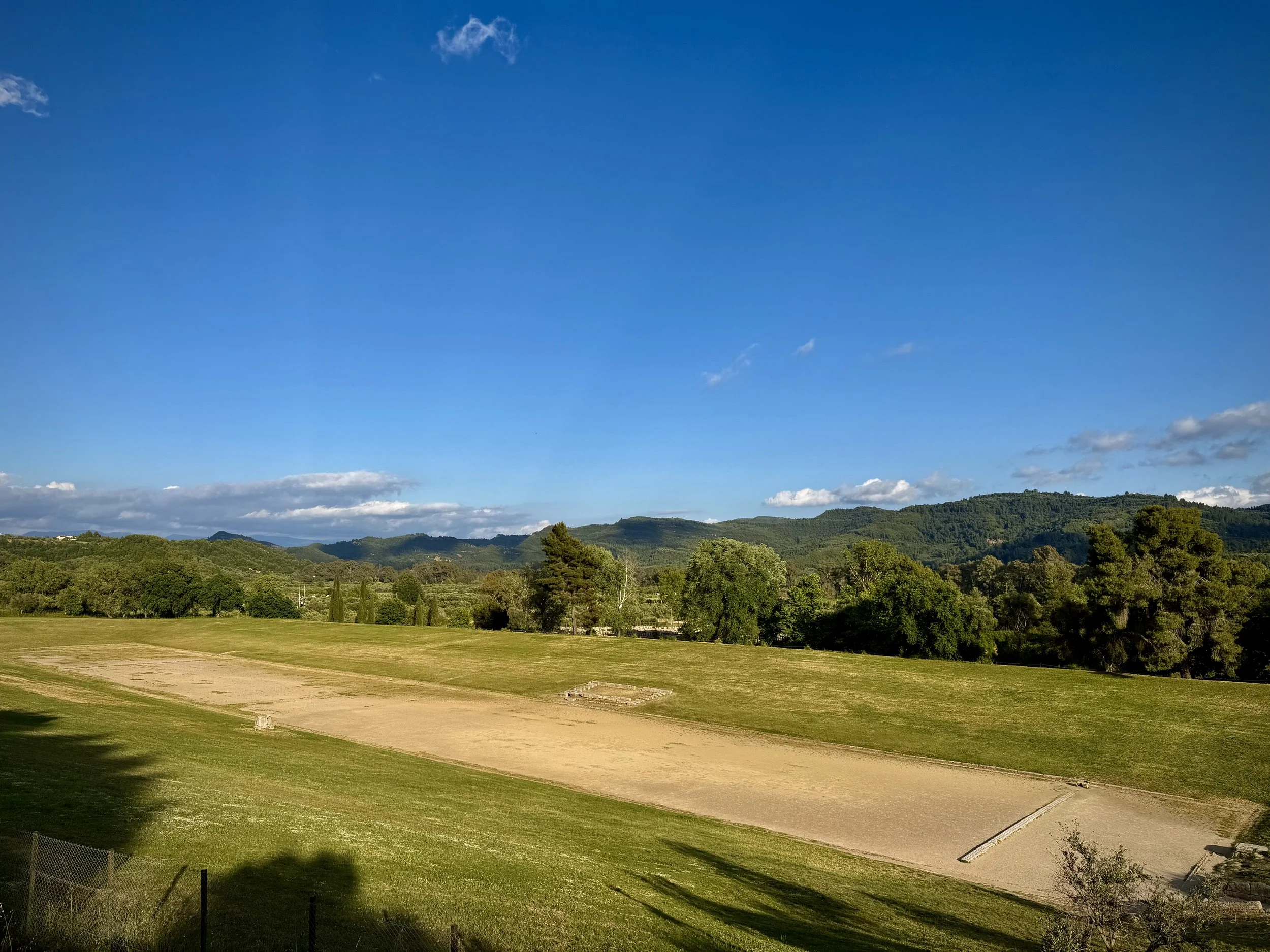
“If Zeus were to stand up, he would unroof the temple.”
— Strabo on the statue of Zeus, Geography 8.3.30

Delphi
Delphi - This is Apollo’s oracle on the mountain, the place Greek cities treated as the navel of their world, and the place where a general might still ask whether he ought to put to sea.
The Greeks called it Delphoi. An older name for the same slope was Pytho. The sanctuary stands in Phocis, in Greece, on the south face of Mount Parnassus.
Wikipedia
https://en.wikipedia.org/wiki/Delphi
Founded
People were using this hillside by the late Geometric and early Archaic centuries, in the 800s and 700s BCE. The Temple of Apollo was rebuilt after a fire in 548 BCE and again after an earthquake in 373 BCE. The sanctuary was closed in the late fourth century CE.
Quote
“I know the number of the sands and the measure of the sea.”
— the Pythia to Croesus of Lydia, recorded by Herodotus in Histories 1.47
History
Delphi was never a harbour town that later acquired a famous temple. It was a sanctuary that made the harbours below it matter. Greeks said two eagles sent out by Zeus met over this slope, and that the stone in the inner room of the temple was the omphalos, the navel of the earth. The god who owned the place was Apollo. In the Homeric Hymn to Apollo he kills the serpent that held the shrine and takes it for himself. The priestess who spoke for him was the Pythia. Cities sent her questions. They also sent treasure, which is why the path up the hill is lined with treasuries rather than houses.
You walk that path still. It is called the Sacred Way, and it switchbacks through the dedications of one city-state after another. The Athenian Treasury has been rebuilt and still stands on its terrace. Athens put a portion of Marathon into that building, and a portion of civic pride along with it. The Siphnian Treasury was richer. Most of it now lives in the museum. Above the treasuries the Temple of Apollo is a platform and a stand of columns rather than a complete room, which is enough. The theatre rests against the temple’s shoulder and is still used in summer. Higher still, the stadium held the Pythian Games, Apollo’s answer to what Zeus had at Olympia.
Herodotus is the writer who makes this hillside useful to a sailor. Croesus asked whether he should make war on Persia and was told that he would destroy a great empire. He did. It was his own. Before Salamis the Athenians were told to trust the wooden wall. Themistocles read the oracle as a fleet, not as a fence around the Acropolis. After the Persian Wars the Greeks raised the Serpent Column from the spoils of Plataea. The column later went to Constantinople, but the argument was made here.
Alexander came to Delphi. Hellenistic kings and Roman emperors came after him, Hadrian among them. Nero carried statues away. By late antiquity the voice of the place had thinned, and the Christian emperors shut the oracle down. The village of Kastri sat on top of the ruins until French excavators began to move it in 1892. The terraces you walk now are that excavation.
For anyone using this guide, Delphi is the clearest example of an oracle sanctuary that still has to be reached from a working gulf harbour. You do not sail to the Pythia. You sail to Itea or Galaxidi, and then you climb.
Location
Delphi, Phocis, Greece, on the south slope of Mount Parnassus.
Coordinates
The sanctuary: 38° 28.95′ N, 022° 30.05′ E
Itea port and marina, the nearest working quay: about 38° 26.0′ N, 022° 25.5′ E
Galaxidi harbour: about 38° 22.6′ N, 022° 23.0′ E
From the water
You will not see the temple from the cockpit. What you see from the Corinthian Gulf is Parnassus and a fold of hills. The sanctuary faces the valley, not the sea. The relationship is still a maritime one. The gulf is how most visitors from the west would have arrived, and it is how you will arrive if you are coming by boat.
Cruising access
Galaxidi is the harbour to aim for if you have a choice. It is well sheltered, the town is pleasant, and a taxi to Delphi takes something like half an hour to forty minutes. Itea is closer, perhaps twenty or twenty-five minutes by road, but it is a working and commercial port and a less comfortable place to leave the boat.
There is no question of walking from the quay to the ruins. The site sits well inland and well up. In summer the coaches from Athens fill the terraces by mid-morning, so an early start from the harbour is worth the alarm. In winter the opening hours shrink. The gulf passage itself is straightforward from the Corinth Canal or from the northern Peloponnese. The mountain road is the only part of the day that asks for patience.
Museum
The Delphi Archaeological Museum stands next to the sanctuary and should not be treated as an extra. The bronze Charioteer is here, along with the Siphnian frieze, the omphalos, and a great deal of ivory and bronze that the hillside itself no longer holds. The ticket is usually combined with the archaeological site.
Practical notes
Give the place three or four hours if you mean to see both the slope and the museum. The Castalian Spring is beside the road as you come in. Afternoon light is kinder to the temple terrace and the theatre. The museum is kinder if you walk through it while you are still fresh. A night in Galaxidi after the visit is a better plan than driving back toward the Canal in the same afternoon.
Pilot books
Heikell’s Greek Waters Pilot covers the Corinthian Gulf, Itea, and Galaxidi. Look there for the harbour, not for a plan of the sanctuary.
From here
Galaxidi is the place you will actually want to spend the evening. Ancient Corinth and the harbour at Lechaion sit at the other end of the same gulf, on the far side of the Canal. Delos is Apollo’s island sanctuary, in a different sea and a different week of the voyage. Olympia is the other great pan-Hellenic gathering place; it is also a taxi ride, this time from a harbour on the west coast of the Peloponnese.
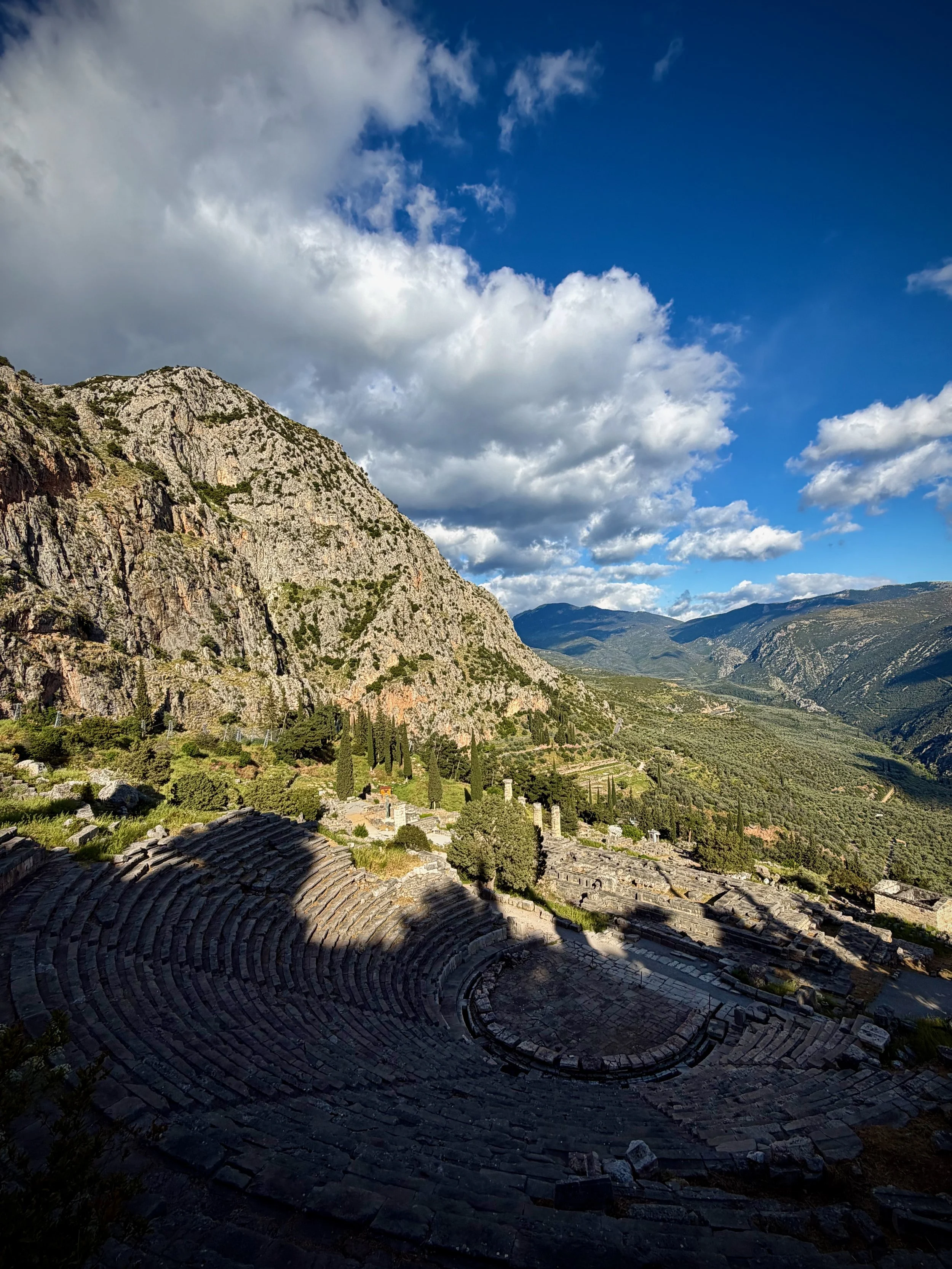
Delphi
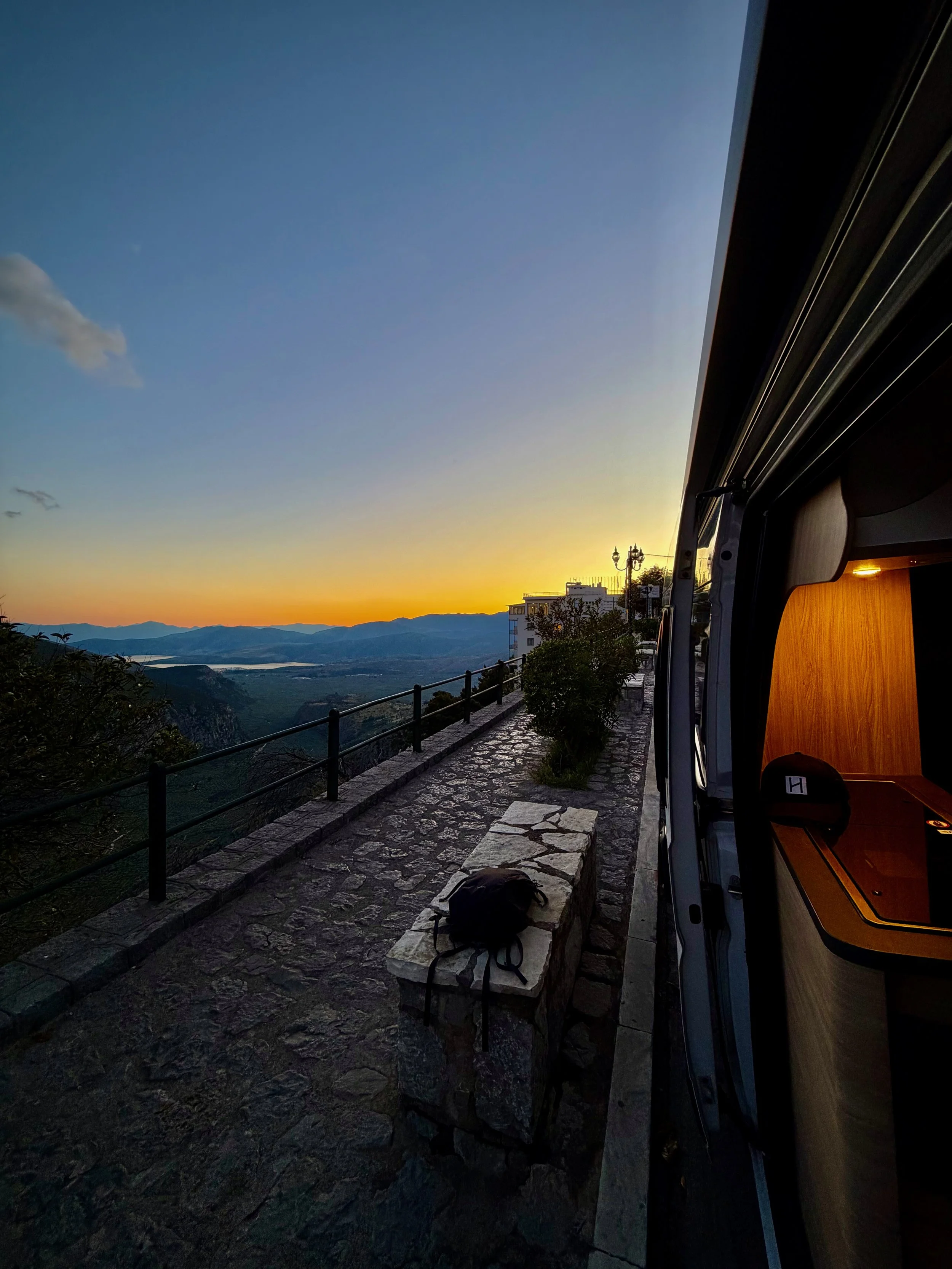
Stick around in town for a late evening meal after visiting Delphi