
The Greeks called it Mykēnai, or Mykēnē. The ruins stand in Argolis, in the Peloponnese, in Greece.
Wikipedia
https://en.wikipedia.org/wiki/Mycenae
Founded
A palace community stood on this ridge from about 1700 or 1600 BCE. The city was at its height between 1400 and 1200 BCE. The Lion Gate and the great walls belong to the years around 1250 BCE. The palatial world here ended in the destructions of about 1200 BCE, and Mycenae was never again a capital.
Quote
“Mycenae, rich in gold.”
— Homer, Iliad, the epithet he returns to when he names Agamemnon’s city
History
Mycenae occupies a low limestone ridge at the head of the Argive plain. From the walls you can look south toward the gulf that still holds Nafplio. In the Late Bronze Age this was not a provincial fort. It was the name-site of a civilization. Palaces of the same world stood at Tiryns, Pylos, Thebes, and, after the Mycenaean takeover of Crete, at Knossos. The Linear B tablets call the ruler the wanax. Homer, writing centuries later in a poorer age, still knew this hill as Agamemnon’s seat, the commander who led the catalogue of ships against Troy.
The walls are what later Greeks called Cyclopean. The blocks are so large that people who no longer remembered the builders decided only a Cyclops could have set them. You enter under the Lion Gate, finished around 1250 BCE. Two lions, now without their heads, stand on either side of a column above a single stone lintel. It is the oldest monumental sculpture in Europe that is still in its original place.
Just inside the gate is Grave Circle A. In 1876 Heinrich Schliemann dug here looking for Agamemnon and came up with gold masks, decorated daggers, and cups. The most famous mask is too early for any historical king of a Trojan War. It belongs to the sixteenth century BCE, three hundred years before the date most scholars would give a conflict at Troy. What Schliemann found was the royal dead of an earlier Mycenaean generation, and the moment modern archaeology decided that Homer might have been pointing at a real hill rather than a story.
The palace on the summit follows the megaron plan: a hearth, a throne room, and the storerooms that kept a palace alive. It burned in the same wave of destruction that ended the palatial world around 1200 BCE. Below the citadel, along the modern road, the Treasury of Atreus stands in its own cutting. It is a tholos tomb, reached by a passage thirty-five metres long. The inner lintel weighs on the order of a hundred and twenty tons. The corbelled dome is fourteen and a half metres across. Romans had already looted it. Lord Elgin later took the decorated columns from the façade. Pieces of them are now in London and in Athens. The engineering is the reason to go in. No classical temple on this coast is put together the way that tomb is.
Mycenae and Tiryns were inscribed together as a UNESCO World Heritage Site in 1999. For anyone arriving by boat the pairing is the point. Tiryns is the citadel nearer the water. Mycenae is the inland throne. If you only see the Venetian walls of Nafplio, you have not yet seen the Bronze Age that named this plain.
The gold is not on the hill. Most of what Schliemann took out of Grave Circle A lives in the National Archaeological Museum in Athens. The museum beside the site holds what later excavations left in Argolis. It is better to know that before you walk in, so you do not look for the mask under the Lion Gate.
Location
Mykines, Argolis, Peloponnese, Greece.
Coordinates
The citadel: 37° 43.85′ N, 022° 45.38′ E
Nafplio harbour, which is the sailor’s door: about 37° 34.0′ N, 022° 48.0′ E
The nearest sea is roughly sixteen kilometres to the south-southeast across the Argive plain.
From the water
You will not see Mycenae from the boat. The ridge sits inland, and the walls do not rise against the sky in the way Monemvasia does. What you see from Nafplio is the plain and the hills behind it. The relationship is still a coastal one. The gulf is how the palaces of this plain were tied to the Aegean, and it is how you will reach them.
Cruising access
Nafplio is the place to leave the boat. It has a town quay, a marina, and the shops and yards that make a few days in the Argolic Gulf easy. Tolo and Drepano are possible alternatives on the same gulf. From Nafplio the road to Mycenae takes twenty to twenty-five minutes by taxi or hired car, a distance of about twenty-four kilometres.
There is no dinghy landing at the ruins and no honest way to treat this as a walk from the beach. It sits inside the guide’s coastal range by straight-line distance to the gulf, not by the time it takes to get your shoes wet.
Museum
The Archaeological Museum of Mycenae stands at the site and is included with the ticket. If you later have a day in Athens, the National Archaeological Museum is where the gold from Grave Circle A is shown, including the mask that is still called Agamemnon’s. The museum in Nafplio is a good third stop if you are back in town with an hour to spare.
Practical notes
One ticket covers the citadel, the Treasury of Atreus, and the site museum. The tholos is down the road from the main gate, not inside the walls, so it is easy to drive past it on the way out and have to turn around. The plateau is bare stone. In summer you will want an early start and water in the bag. Tiryns lies on the road back toward Nafplio and is close enough to the water that the same afternoon can hold both citadels without turning into a scramble. Adding Epidauros to that same day is how people see none of them properly.
Pilot books
Heikell’s Greek Waters Pilot will give you Nafplio and the Argolic Gulf. Mycenae appears there as an inland excursion, not as a harbour plan.
From here
Tiryns is the UNESCO partner of this hill and the citadel that stands nearer the sea. Nafplio is where the boat will be waiting. Ancient Corinth lies to the north, along the same line that runs up toward the Isthmus. Epidauros is a separate day if you want the theatre. Troy is the other end of the Iliad, on the Turkish shore, and belongs to a later passage.
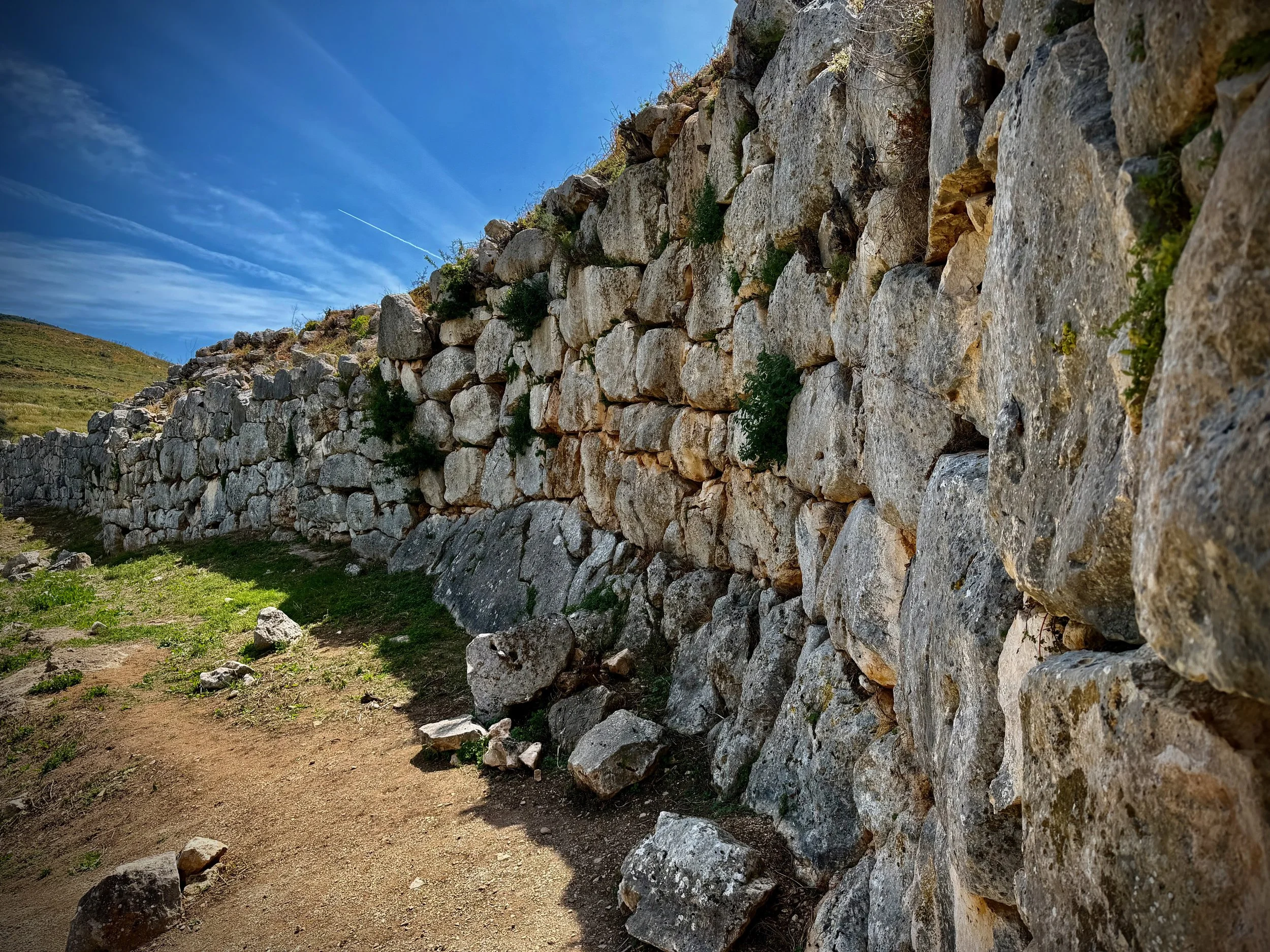
The Cyclopean Wall of Mycenae
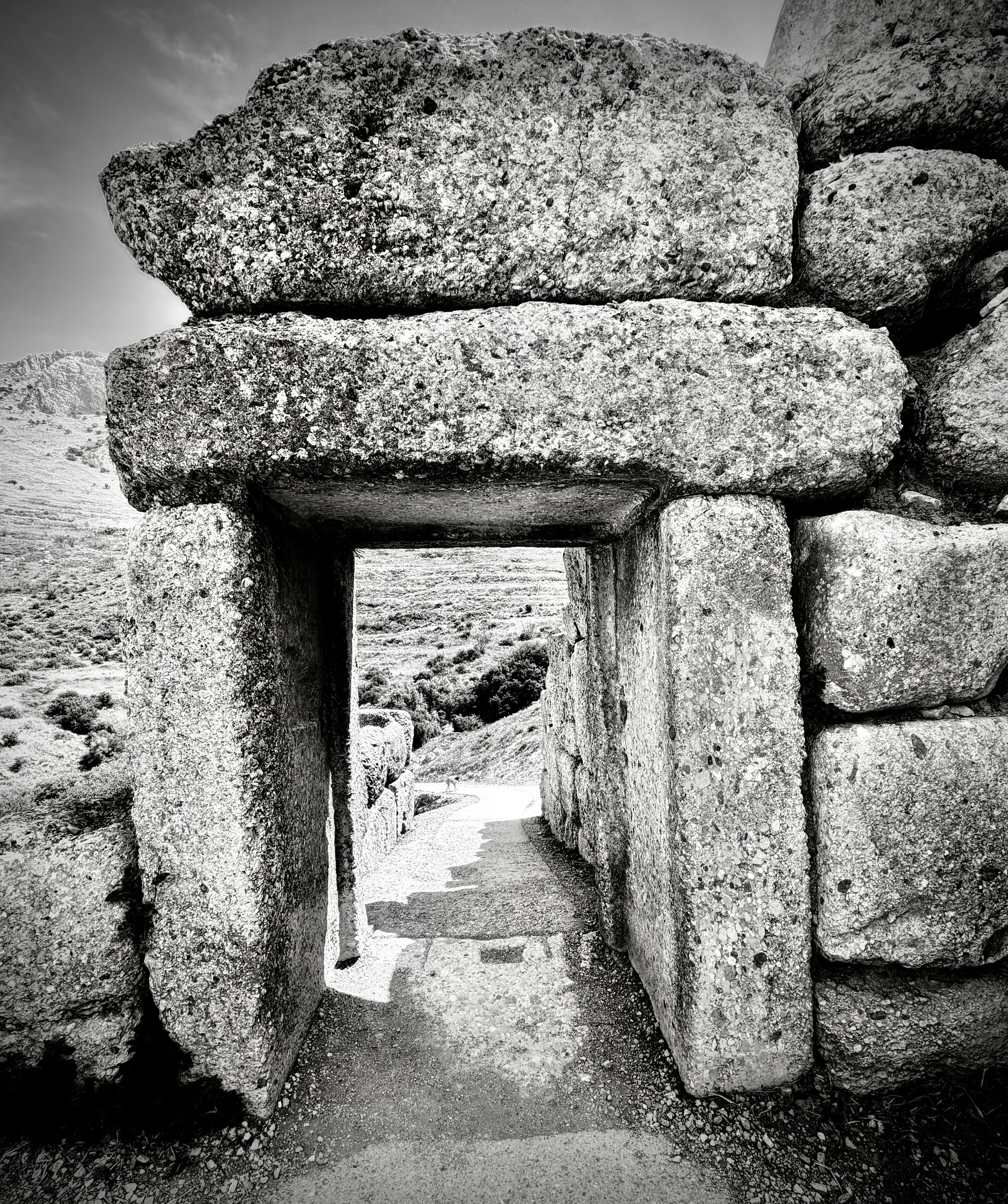
“Mycenae, rich in gold.”
— Homer, Iliad, the epithet he returns to when he names Agamemnon’s city